
Process
How the work gets done.
Not a rigid gate process. A set of principles, applied through loose phases that flex to the project, with AI accelerating every step and human judgment deciding what ships. This is the path from complexity to clarity.
Four rules that don’t flex.
Phases adapt to the project. These don’t.
Start with the business problem, not the screen
Every engagement begins by clarifying the vision and aligning stakeholders on what success means. UI comes later; it’s the output of the process, never the input.
Diverge fast, converge with judgment
AI multiplies the option space in hours instead of weeks. Then the humans take over, curating the many options back down to the few ideas the problem actually needs.
Evidence over opinion
Research isn’t a report, it’s a decision-making tool. Customer, user, and market evidence gets synthesized into action while it’s still fresh enough to change minds.
Design intent survives to production
Handoffs are where good decisions go to die. I stay engaged through build, working in the same tools and code as the engineers iteratively shipping the product.
Diverge faster, converge smarter.
This is the shape of the middle of every project, and the place AI has changed the most.
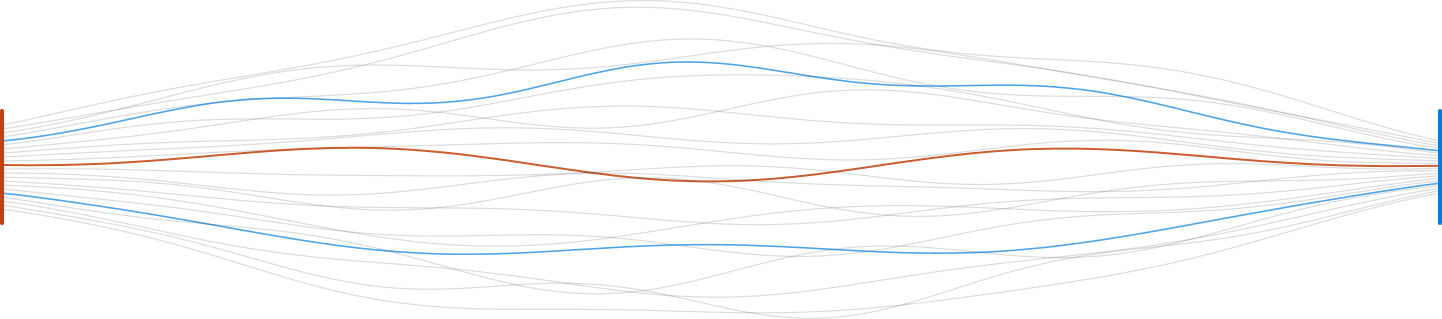
A flexible arc, not a gauntlet.
Projects move through four overlapping phases. Small efforts might compress them into a week; platform modernizations stretch them across quarters. The sequence holds; the ceremony doesn’t.
Choose the problem worth solving
Vision clarification, stakeholder alignment, and audits of what exists: the technology, the competitors, the constraints. The output is a shared definition of success that leadership, product, and engineering all recognize as theirs.
Where AI accelerates
Rapid synthesis of documentation, feedback backlogs, and competitive landscapes, turning weeks of desk research into days.
In practice: Cross-product audits at SS&C aligned medical and pharmacy roadmaps and sharpened the sales team’s GTM priorities.
Gather evidence that changes minds
Qualitative and quantitative research with customers, users, and the market: interviews, field research, concept testing, and collaborative workshops that make stakeholders co-owners of the findings rather than an audience for them.
Where AI accelerates
Sentiment synthesis at scale, from app-store reviews to support transcripts, surfacing patterns a human read would miss or take months to find.
In practice: App-store sentiment synthesis at Paysign set the redesign priorities for the B2C mobile roadmap.
03
Explore & Align
Make options real enough to judge
Concepts, wireframes, and working prototypes at whatever fidelity the decision needs. This is where the diverge/converge model above runs hottest, including live wireframing sessions where stakeholders debate requirements on a shared canvas in real time. The phase ends in commitment: a converged direction, product owner sign-off, and dev-ready specs that engineering has already seen coming.
Where AI accelerates
High-realism interactive prototypes built in days without dev support, validating real interactions, roles, and permissions before a sprint is spent.
In practice: A role- and permission-aware prototype at Lab49, delivered in under a week, caught defects before development and secured product owner sign-off.
04
Ship & Scale
Carry intent through build, then compound it
Build starts from a committed direction, not a surprise. Direct partnership with full-stack engineers, sequencing design delivery by implementation complexity and data availability so teams stay unblocked. Design systems turn the shipped work into reusable infrastructure, and post-launch evidence feeds the next Frame.
Where AI accelerates
Going straight from approved design to production-framework code in a pull request, plus AI-assisted documentation that keeps systems adoptable.
In practice: DomaniRx shipped with themeable, accessible design systems that kept five distributed squads consistent and cut plan implementation timelines.
See where this process has landed.
The proof points on the home page, and the career behind them on the about page, all came out of this way of working. Reach out, to discuss further.